Class 9 Work and Energy Numericals

Class 9 Work and Energy Numericals

Work and energy solved numericals


Numerical 1: Work Done by a Constant Force

Q1. A force of 12 N acts on an object and moves it through a distance of 4 m in the direction of the force. Find the work done.

Solution:

Given:
Force, F = 12 N
Displacement, s = 4 m

Formula:
Work done, W = F × s

Calculation:
W = 12 × 4
W = 48 J

Answer: Work done = 48 joules


Numerical 2: Zero Work Done

Q2. A person pushes a wall with a force of 200 N for 5 minutes, but the wall does not move. Find the work done.

Solution:

Displacement, s = 0 (wall does not move)

Formula:
W = F × s

W = 200 × 0 = 0 J

Answer: Work done = 0 joule
Because displacement is zero


Numerical 3: Work Done Against Gravity

Q3. A boy lifts a bag of mass 10 kg to a height of 2 m. Calculate the work done.
(Take g = 10 m/s²)

Solution:

Given:
m = 10 kg
h = 2 m
g = 10 m/s²

Formula:
W = mgh

Calculation:
W = 10 × 10 × 2
W = 200 J

Answer: Work done = 200 joules


Numerical 4: Kinetic Energy

Q4. Find the kinetic energy of a car of mass 1000 kg moving with a speed of 20 m/s.

Solution:

Given:
m = 1000 kg
v = 20 m/s

Formula:
KE = ½ mv²

Calculation:
KE = ½ × 1000 × (20)²
KE = 500 × 400
KE = 2,00,000 J

Answer: Kinetic energy = 2 × 10⁵ J


Numerical 5: Change in Kinetic Energy

Q5. A ball of mass 5 kg is initially at rest. It starts moving with a speed of 6 m/s. Find the work done on the ball.

Solution:

Initial velocity, u = 0
Final velocity, v = 6 m/s
Mass, m = 5 kg

Formula:
Work done = Change in kinetic energy

KE = ½ mv²

KE = ½ × 5 × 36
KE = 90 J

Answer: Work done = 90 joules


Numerical 6: Potential Energy

Q6. Calculate the potential energy of an object of mass 8 kg placed at a height of 5 m.
(g = 10 m/s²)

Solution:

Given:
m = 8 kg
h = 5 m
g = 10 m/s²

Formula:
PE = mgh

Calculation:
PE = 8 × 10 × 5
PE = 400 J

Answer: Potential energy = 400 joules


Numerical 7: Law of Conservation of Energy

Q7. A stone of mass 2 kg is dropped from a height of 10 m.
Find its kinetic energy just before hitting the ground.
(g = 10 m/s²)

Solution:

Initial potential energy = mgh

PE = 2 × 10 × 10 = 200 J

According to law of conservation of energy,
Final KE = Initial PE

Answer: Kinetic energy = 200 joules


Numerical 8: Power

Q8. A man lifts a load of 500 N to a height of 4 m in 10 seconds. Find his power.

Solution:

Work done = Force × Height
W = 500 × 4 = 2000 J

Time, t = 10 s

Formula:
Power = Work / Time

P = 2000 / 10
P = 200 W

Answer: Power = 200 watts


Numerical 9: Electrical Energy Consumption

Q9. An electric bulb of 100 W glows for 5 hours. Find the energy consumed in joules.

Solution:

Power = 100 W
Time = 5 hours = 5 × 3600 = 18000 s

Formula:
Energy = Power × Time

Energy = 100 × 18000
Energy = 18,00,000 J

Answer: Energy consumed = 1.8 × 10⁶ joules


Numerical 10: Velocity from Kinetic Energy

Q10. The kinetic energy of an object is 450 J and its mass is 10 kg. Find its velocity.

Solution:

KE = ½ mv²

450 = ½ × 10 × v²
450 = 5v²
v² = 90
v = √90 ≈ 9.5 m/s

Answer: Velocity ≈ 9.5 m/s


Exam Central

Numerical 11: Combined Concept (PE → KE)

Q11. A stone of mass 2 kg is thrown vertically upward with a speed of 10 m/s.
Find the maximum height reached by the stone.
(Take g = 10 m/s²)

Solution:

Given:
m = 2 kg
u = 10 m/s
g = 10 m/s²
v = 0 (at maximum height)

Using energy conservation:

Initial KE = Final PE

½mu² = mgh

½ × 2 × (10)² = 2 × 10 × h

100 = 20h

h = 5 m

Answer: Maximum height = 5 metres


Numerical 12: Work Done by Retarding Force

Q12. A car of mass 1200 kg moving at 20 m/s is brought to rest by applying brakes.
Find the work done by the braking force.

Solution:

Given:
m = 1200 kg
u = 20 m/s
v = 0

Work done = Change in kinetic energy

W = ½m(v² − u²)

W = ½ × 1200 × (0 − 400)
W = −240000 J

Answer: Work done = –2.4 × 10⁵ J
Negative sign shows work done against motion


Numerical 13: Power While Climbing Stairs (Very Important)

Q13. A student of mass 50 kg climbs a staircase of 30 steps, each step being 20 cm high, in 12 seconds.
Find the power developed by the student.
(Take g = 10 m/s²)

Solution:

Mass, m = 50 kg
Height of one step = 20 cm = 0.2 m
Total height = 30 × 0.2 = 6 m

Weight = mg = 50 × 10 = 500 N

Work done = mgh
W = 50 × 10 × 6 = 3000 J

Time, t = 12 s

Power = Work / Time

P = 3000 / 12
P = 250 W

Answer: Power developed = 250 watts


Numerical 14: Energy at Halfway Point

Q14. An object of mass 4 kg is dropped from a height of 20 m.
Find its kinetic energy when it is at a height of 10 m above the ground.
(Take g = 10 m/s²)

Solution:

Initial potential energy = mgh

= 4 × 10 × 20
= 800 J

Potential energy at 10 m height:

= 4 × 10 × 10
= 400 J

Using conservation of energy:

KE = Total energy − Remaining PE

KE = 800 − 400
KE = 400 J

 Answer: Kinetic energy = 400 joules


Numerical 15: Multiple Appliances Energy Consumption

Q15. Three electrical appliances of power 500 W, 1000 W, and 1500 W work for 2 hours each.
Find the total energy consumed in kilowatt-hour (kWh) and in joules.

Solution:

Total power = 500 + 1000 + 1500
Total power = 3000 W = 3 kW

Time = 2 hours

Energy in kWh = Power × Time

Energy = 3 × 2
Energy = 6 kWh

Conversion:
1 kWh = 3.6 × 10⁶ J

Energy in joules = 6 × 3.6 × 10⁶
= 21.6 × 10⁶ J

Answer:
Energy consumed = 6 kWh
= 2.16 × 10⁷ joules
 

Is Matter Around us Pure Class 9 Case Based Questions

Class 9 is matter around us pure

Is Matter Around Us Pure Class 9 MCQ – 2

Class 9 is matter around us pure

Class 9 Is Matter Around Us Pure? MCQ – 1

Class 9 is matter around us pure

Class 9 Motion mcq

Class 9 Motion Notes

Class – 9 CBSE

Chapter –  Motion 

Class 9 Physics Chapter 1 notes

  1. Motion:
    An object is said to be in motion if it changes its position with respect to its surroundings.
    Example: A car moving on the road or a fan rotating.
  2. Rest:
    A body is at rest if it does not change its position with respect to its surroundings.
    Example: A book lying on a table.
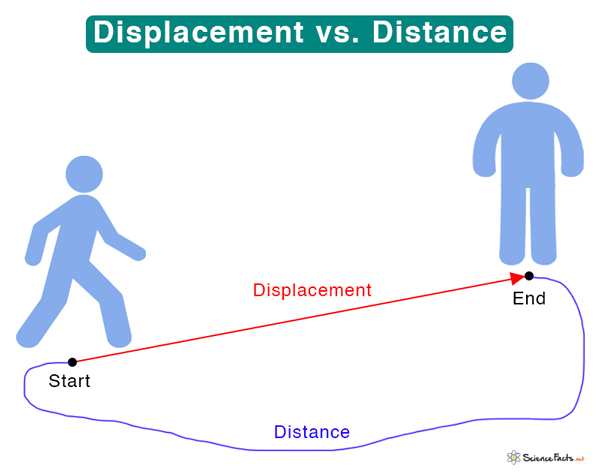
  3. Displacement:
    The shortest distance between the initial and final positions of an object.
    SI Unit: metre (m)
    Example: If you walk from your home to a friend’s house in a straight line, that’s displacement.
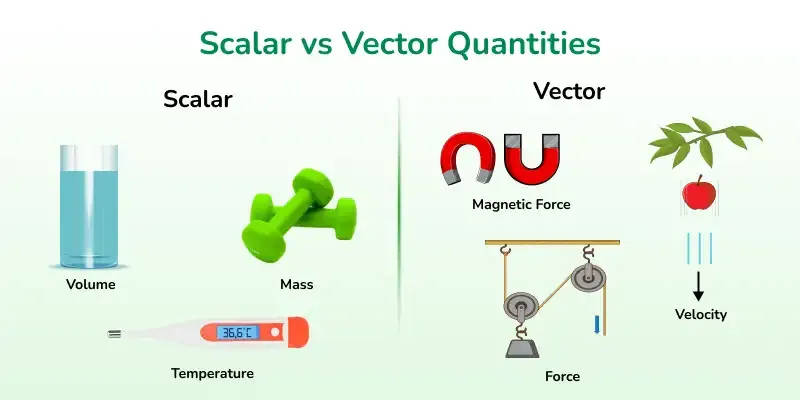
  4. Vector:
    Physical quantities having both magnitude and direction.
    Example: Velocity, force.
  5. Scalar:
    Physical quantities having only magnitude and no direction.
    Example: Speed, distance, time.
  6. Uniform Motion:
    A body covers equal distances in equal intervals of time.
    Example: A car moving at a constant speed of 60 km/h on a highway.
  7. Non-uniform Motion:
    A body covers unequal distances in equal time intervals or equal distances in unequal time intervals.
    Example: A car stuck in traffic keeps changing speed.
  8. Speed:
    Speed = Distance / Time
    SI Unit: m/s
    Example: A train covers 300 km in 3 hours, so speed = 100 km/h.
  9. Average Speed:
    Average Speed = Total Distance Travelled / Total Time Taken
  10. Locomotion:
    Movement of animals from one place to another.
    Example: A dog running, a bird flying.
  11. Velocity:
    The displacement covered per unit time in a given direction.
    Velocity = Displacement / Time
    SI Unit = m/s
  12. Uniform Velocity:
    Equal displacement in equal intervals of time in a particular direction.
  13. Variable Velocity:
    Displacement changes in unequal intervals of time or direction keeps changing.
    Example: A bus moving in a city street with turns and stops.
  14. Acceleration:
    Rate of change of velocity.
    Acceleration = (Final Velocity – Initial Velocity) / Time
    SI Unit = m/s²
  15. Retardation or Deceleration:
    Negative acceleration; when the velocity of an object decreases.
    Example: A bicycle slowing down before stopping.
  16. Uniform Acceleration:
    Velocity changes by equal amounts in equal intervals of time.
    Example: Free fall under gravity.
  17. Variable Acceleration:
    Velocity changes by unequal amounts in equal time intervals.
    Example: A car speeding up irregularly in traffic.

Equations of Motion (For Uniform Acceleration)

  1. v = u + at
  2. s = ut + ½ at²
  3. v² = u² + 2as
    Where:
  • s = Distance
  • u = Initial velocity
  • v = Final velocity
  • a = Acceleration
  • t = Time

Graphs

  1. Distance-Time Graph:
    • Shows time vs distance.
    • Slope = Speed
      Example: A straight line shows uniform speed.
  1. Velocity-Time Graph:
    • Shows time vs velocity.
    • Slope = Acceleration
    • Area under the graph = Distance covered

Circular Motion Concepts

  1. Uniform Circular Motion:
    When a body moves in a circular path with uniform speed.
    Example: A satellite orbiting the Earth.
  2. Angular Displacement:
    Angle swept by the radius of a circular path in a given time.
  3. Angular Velocity (ω):
    Angular Velocity = Angle swept / Time = θ / t
    Units: rad/s
  4. Time Period (T):
    Time taken to complete one full revolution.
  5. Frequency (f):
    Number of revolutions per unit time.
    f = 1 / T


Relation Between Linear and Circular Motion

  1. Linear Velocity (v):
    v = 2πr / T = rω
  2. Relation Between Linear Velocity and Time Period:
    v = Circumference / Time period


Notations of Physical Quantities

Quantity Symbol
Distance s
Speed v
Time t
Acceleration a
Initial Velocity u
Final Velocity v
Average Velocity


Useful Formulas and Equations

  1. v = u + at
  2. s = ut + ½ at²
  3. v² = u² + 2as
  4. Average Velocity (v̅) = (u + v) / 2
  5. s = v̅ × t = [(u + v)/2] × t

.


Class 9 Fundamental Unit of Life MCQ

Class 9 Matter in our Surrounding MCQ

Class 9 Matter in Our Surrounding Extra Questions

Class 9

Matter in Our Surrounding

Extra Questions


  1. A substance has no mass. Can we consider it as matter?
    Ans. No, matter must have mass and occupy space.


  1. Select the substances from the following which do not have the property of sublimation:
    Camphor, Potassium permanganate, Copper sulphate, Naphthalene.

    Ans. Potassium permanganate and copper sulphate do not have the property of sublimation.


  1. Evaporation causes cooling. Why?
    Ans. Evaporation needs heat energy which it takes from surrounding and leads to degrees in temperature, i.e cooling take place.


  1. Convert 300 K into Celsius scale and –10°C into Kelvin scale.
    Ans.
    (i) 300 K – 273 = 27°C
    (ii) –10°C + 273 = 263 K


  1. Name the property of gases due to which it is possible to fill CNG in cylinders for using as fuel in cars.
    Ans. Gases can be easily compressed.


  1. Rubber band changes its shape. Is it solid?
    Ans. Yes, it is solid because it regains its shape.


  1. Does evaporation cause a physical change or a chemical change?
    Ans. Evaporation is a physical change.


  1. List any two properties of particles of matter.
    Ans.
    (i) There is space between particles of matter.
    (ii) The particles of matter are extremely small in size which cannot be seen even with a powerful microscope.


  1. Give reasons to explain why it takes longer to dry wet clothes in humid weather?
    Ans. It is because air is already saturated with water vapours therefore it will not be able to hold more water vapours easily.


  1. Convert 370 K into Celsius Scale (°C).
    Ans. 370 K – 273 = 97°C


  1. Arrange three states of matter in the increasing order of rate of diffusion.
    Ans. Rate of Diffusion : Solids  <  Liquids  <  Gases


  1. How does spreading of wet clothes quicken their drying? Explain.
    Ans. It increases exposed surface area due to which water gets evaporated at faster rate.


  1. What is dry ice? What happens when the pressure under which it is stored is decreased to 1 atmosphere?
    Ans. Dry ice is solid carbon dioxide. If pressure is decreased it will change into vapours.


  1. With which name is the phenomenon of changing of a liquid into its vapours at temperature below its boiling point known?
    Ans. Sublimation.


  1. The melting points of three solids X, Y and Z are 298 K, 314 K and 398 K respectively. Arrange these in increasing order of their inter particle force of attraction.
    Ans. X < Y < Z is the order of increasing inter particle attraction. Higher the force of attraction, higher will be melting point.


  1. What is full form of CNG? Mention its one property which makes it so important.
    Ans. Compressed Natural Gas. It does not create pollution on combustion, it is clean fuel which makes it so important.


  1. Write one important characteristic property of particles of matter.
    Ans. Particles of matter attract each other.


  1. When camphor is heated in a China dish, it changes into gas without changing into liquid. What is the name given to this change of state?
    Ans. Sublimation.


  1. Sponge is solid but still it can be compressed. Why?
    Ans. Sponge has pores which has air, therefore, it can be compressed.


  1. Why is the temperature remain constant during sublimation?
    Ans. It is because heat of vaporisation and fusion overcome the force of attraction between particles.


  1. What is evaporation?
    Ans. It is process of converting liquid into vapours.


  1. When a solid melts, its temperature remains constant, so where does the heat energy go? What is the name given to this heat?
    Ans. The heat energy is used to overcome intermolecular force of attraction. It is called latent heat of fusion.


  1. Convert the following thermometer readings into kelvin –100°C, 200°C.
    Ans.
    –100°C + 273 = 173 K
    200°C + 273 = 473 K


  1. Why is light not considered as a matter?
    Ans. It is because it does not occupy space.


  1. Is smell of clove or cardamom a matter?
    Ans. No, because it does not have mass and does not occupy space.


  1. What happens to the boiling point of a liquid when atmospheric pressure decreases?
    Ans. Boiling point of liquid is the temperature at which its vapour pressure becomes equal to external pressure (atmospheric pressure).
    Thus, when atmospheric pressure decreases, boiling point of liquid also decreases.


  1. What are heterogeneous mixtures?
    Ans. Those mixtures whose composition is not same throughout are called heterogeneous mixtures, e.g. sulphur powder and iron filings.


  1. Why mixture does not have a fixed melting or a fixed boiling point? Give two reasons.
    Ans.
    (a) It does not have fixed composition.
    (b) It does not have uniform ordered arrangement of particles.


  1. When common salt is dissolved in water, what will be the change in volume and why?
    Ans. There is no change in volume. It is because common salt particles occupy the spaces between molecules of water.


  1. Write one similarity between three states of matter.
    Ans
    . All the three states of matter are made up of particles.


  1. What is tincture of iodine?
    Ans
    . A solution of iodine in alcohol is known as ‘tincture of iodine’.


  1. On suffering from fever which will lower down your body temperature more, ice or ice cold water? why?
    Ans. Ice will lower down body temperature more because it will take heat of fusion from our body and feed fever will come down faster.


  1. Define latent heat of vaporisation.
    Ans
    . Latent heat of Vaporisation. It is defined as heat required to convert 1 kg of liquid into vapours completely at its boiling point.


  1. People sprinkle water on open ground or roof on a hot sunny day. Why?
    Ans. It is because water gets evaporated by taking heat from surface of roof or ground and causes cooling.


  1. Give reason : During summer sitting under a fan makes us comfortable.
    Ans. Fan takes hot air up and cold air comes down which makes us comfortable. It also helps in evaporation of sweat which causes cooling.


Class – 9 Motion

CSCE TUTORIAL

MOTION

Worksheet – 1

  1. Can the magnitude of the displacement be equal to the distance travelled by an object? Justify by giving an example.


  1. A farmer moves along the boundary of a square field of side 10 m in 40 s. What will be the magnitude of displacement of the farmer at the end of 2 minutes 20 seconds from his initial position?


  1. What does the odometer of an automobile measure?


  1. The odometer of a car reads 2000 km at the start of a trip and 2400 km at the end of the trip. If the trip took 8 h, calculate the average speed of the car in km h–1 and m s–1


  1. A bus decreases its speed from 80 km h–1 to 60 km h–1 in 5 s. Find the acceleration of the bus.


  1. What is the nature of the distance-time graphs for uniform and non-uniform motion of an object? 


  1. What can you say about the motion of an object whose distance-time graph is a straight line parallel to the time axis?


  1. What can you say about the motion of an object if its speed-time graph is a straight line parallel to the time axis? 


  1. What is the quantity which is measured by the area occupied below the velocity-time graph?


  1. He brakes applied to a car produce an acceleration of 6 m s-2 in the opposite direction to the motion. If the car takes 2 s to stop after the application of brakes, calculate the distance it travels during this time.


  1. A trolley, while going down an inclined plane, has an acceleration of 2 cm s-2. What will be its velocity 3 s after the start?


  1. A stone is thrown in a vertically upward direction with a velocity of 5 m s-1. If the acceleration of the stone during its motion is 10 m s–2 in the downward direction, what will be the height attained by the stone and how much time will it take to reach there?


  1. Abdul, while driving to school, computes the average speed for his trip to be 20 km h–1. On his return trip along the same route, there is less traffic and the average speed is 30 kmh–1 What is the average speed for Abdul’s trip?


  1. A ball is gently dropped from a height of 20 m. If its velocity increases uniformly at the rate of 10 m s-2, with what velocity will it strike the ground? After what time will it strike the ground?


  1. State which of the following situations are possible and give an example for each of these:

          (a) an object with a constant acceleration but with zero velocity

          (b) an object moving in a certain direction with an acceleration in the perpendicular direction. 


  1. An artificial satellite is moving in a circular orbit of radius 42250 km. Calculate its speed if it takes 24 hours to revolve around the earth.