
Natural Resources and Their Use Class 8 Questions and Answers Social Science Chapter 1
Exploring Society India and Beyond Class 8 NCERT Solutions
Class 8 Social Science SST Chapter 1 Natural Resources and Their Use Question Answer NCERT Solutions
Q. 1. How do we categorise natural resources?
Ans: Natural resources are categorised based on their origin (biotic and abiotic), renewability (renewable and non-renewable) and use (life, material or energy sources).
Q. 2. What is the connection between the distribution of natural resources and different aspects of life?
Ans: The uneven distribution of resources affects settlement, trade, jobs, development and even international relations. Areas rich in resources often develop faster.
Q. 3. What are the implications of unsustainable use/overexploitation of natural resources?
Ans: It leads to resource depletion, environmental damage, loss of biodiversity and long-term harm to ecosystems and human life.
Page – 3
Q. 4. Take a pause. Look at yourself and the things around you. What is the origin of each of them? At some point, they all lead to nature; even the plastic button on your shirt.
Ans: Everything around us originates from nature. Even a plastic button is made from petroleum, a natural resource. Clothes come from cotton plants, paper from trees and metals from minerals. All man-made items are derived from natural resources.
Page – 4
Q. 5. What might be the different criteria we can use to categorise natural resources?
Ans: Based on use (life/material/energy), renewability (renewable/non-renewable) and origin (biotic/abiotic).
Q. 6. Identify human actions in your surroundings that result in Nature losing her ability to restore and regenerate. What types of interventions can be undertaken to restore Nature’s cycle?
Ans: Actions: cutting trees, overuse of water, pollution.
Interventions: reforestation, water harvesting, pollution control and promoting eco-friendly farming.
Page – 8
Q. 7. Take up a small research study to assess the types of Renewable resources in your region; you may discuss with your teacher the geographical area of your study and sources to access information that you may need. What has been the change in their status over time? Make a small report that identifies the reasons for the change and what may be done.
Ans: Renewable Resources in Aligarh, UP
Main Resources:
Solar energy, groundwater, biomass and farmland
Changes:
- Groundwater is depleting
- Solar use is rising
- Farmland quality slightly declining
Reasons:
Overuse, population growth, climate change
Solutions:
Harvest rainwater, use solar panels and adopt sustainable farming
Conclusion:
Wise use ensures long-term sustainability.
Q. 8. What are the non-renewable resources that you use daily, directly or indirectly? What are the possible renewable substitutes? What are some of the steps that can be taken to transition to renewables?
Ans: Non-renewables: petrol, LPG, plastic.
Substitutes: solar energy, biogas and reusable cloth bags.
Steps: Reduce use, switch to alternatives and awareness.
Page – 9
Q. 10. Observe the map in Fig.1.11. Notice the uneven distribution of important minerals. What types of resources are available in your region? How are they distributed?
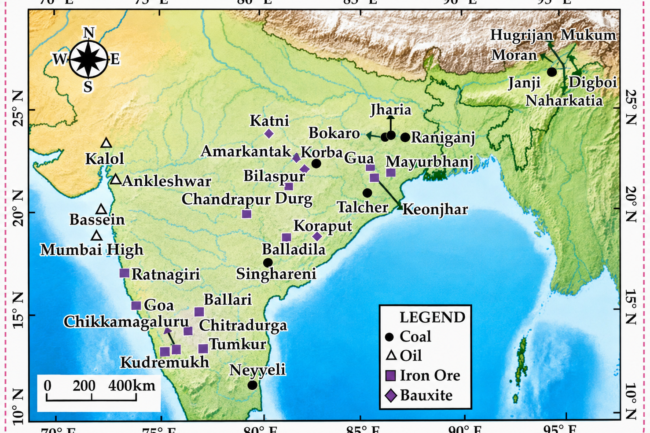
Ans: The map shows that minerals are unevenly distributed across India. Coal is mainly found in eastern and central regions like Jharia, Raniganj, and Korba, as well as in the south at Neyveli and Singareni. Iron ore is abundant in central, eastern, and southern parts, including Bailadila and Mayurbhanj. Bauxite deposits are mostly in central and eastern India, such as Katni and Koraput in southern Odisha. Petroleum and natural gas fields are located along the western coast near Mumbai High and Ankleshwar, and in the northeast at Digboi. This uneven distribution reflects India’s varied geology, with certain regions rich in specific minerals.
Q. 11. Select any two natural resources. Gather information about their availability across different parts of India. Mark them on a map. What do you observe about their distribution? What are the types of economic activities connected with them?
Ans: Coal (Jharkhand and Chhattisgarh) – mining leads to jobs but also pollution.Iron ore (Odisha and Karnataka) – boosts economy but causes deforestation. Responsible use is needed for future generations.
Q. 12. Discuss the implications of extracting natural resources in those parts for current and future generations. Suggest ways in which we can use Nature’s gifts in responsible ways.
Ans: Implications of Overuse:
- Current generation faces pollution and scarcity.
- Future generations may suffer resource shortage and climate problems.
Responsible Use:
- Use resources wisely and avoid waste
- Shift to renewable energy
- Recycle, reuse and plant trees
- Raise awareness for sustainable living.
Q. 13. Find out about such a conflict in the international context. Discuss your findings in the class.
Ans: Nile River conflict among Egypt, Sudan and Ethiopia. Disputes over dam construction and fair water sharing.
Q. 14. What do you think are the different inputs required to enable the use of the natural resources available in different Geographical areas?
Ans: Inputs: technology, skilled labour, infrastructure, capital and planning.
Textbook Questions (Page – 24-25)
Q. 1. What can make what is today a renewable resource a non-renewable resource tomorrow? Describe some actions that can prevent this from happening.
Ans: Overuse or pollution can turn renewable resources into non-renewable.
Prevention: Use resources responsibly, allow regeneration and reduce waste.
Q. 2. Name five ecosystem functions that serve humans.
Ans: Oxygen production, water purification, pollination, soil fertility and climate regulation.
Q. 3. What are renewable resources? How are they different from non-renewable ones? What can people do to ensure that renewable resources continue to be available for our use and that of future generations? Give two examples.
Ans: These are natural resources that regenerate or replenish naturally over time through ecological cycles. Their supply can be maintained if used sustainably.
Examples: Solar energy, Forest timber (if harvested responsibly).
Examples- Solar energy and forest timber Coal
Q. 4. Identify cultural practices in your home and neighbourhood that point to mindfulness in the use of natural resources. (Easy)Ans: Examples: rainwater harvesting, using cow dung as fuel, worship of nature and use of earthen pots.Q. 5. What are some considerations to keep in mind in the production of goods for our current use? (Easy)Ans: Use eco-friendly materials, reduce pollution, avoid overexploitation and consider long-term sustainability.
